
How to Choose a Beginner Cross Stitch Pattern
Choose an easy first cross stitch pattern by checking size, colors, stitch types, and chart clarity, with animal examples and a free-pattern checklist.
A good beginner cross stitch pattern has a clear shape, a manageable number of stitches, a few easy-to-distinguish colors, and a readable chart with a thread key. Start with one motif you like, rather than a whole collection. Full crosses and connected areas of color give you fewer things to learn at once.
Small cross stitch patterns are not automatically easy. A tiny design with frequent color changes can demand more attention than a larger shape filled with one color. Before choosing, look at the actual chart as well as the finished picture.
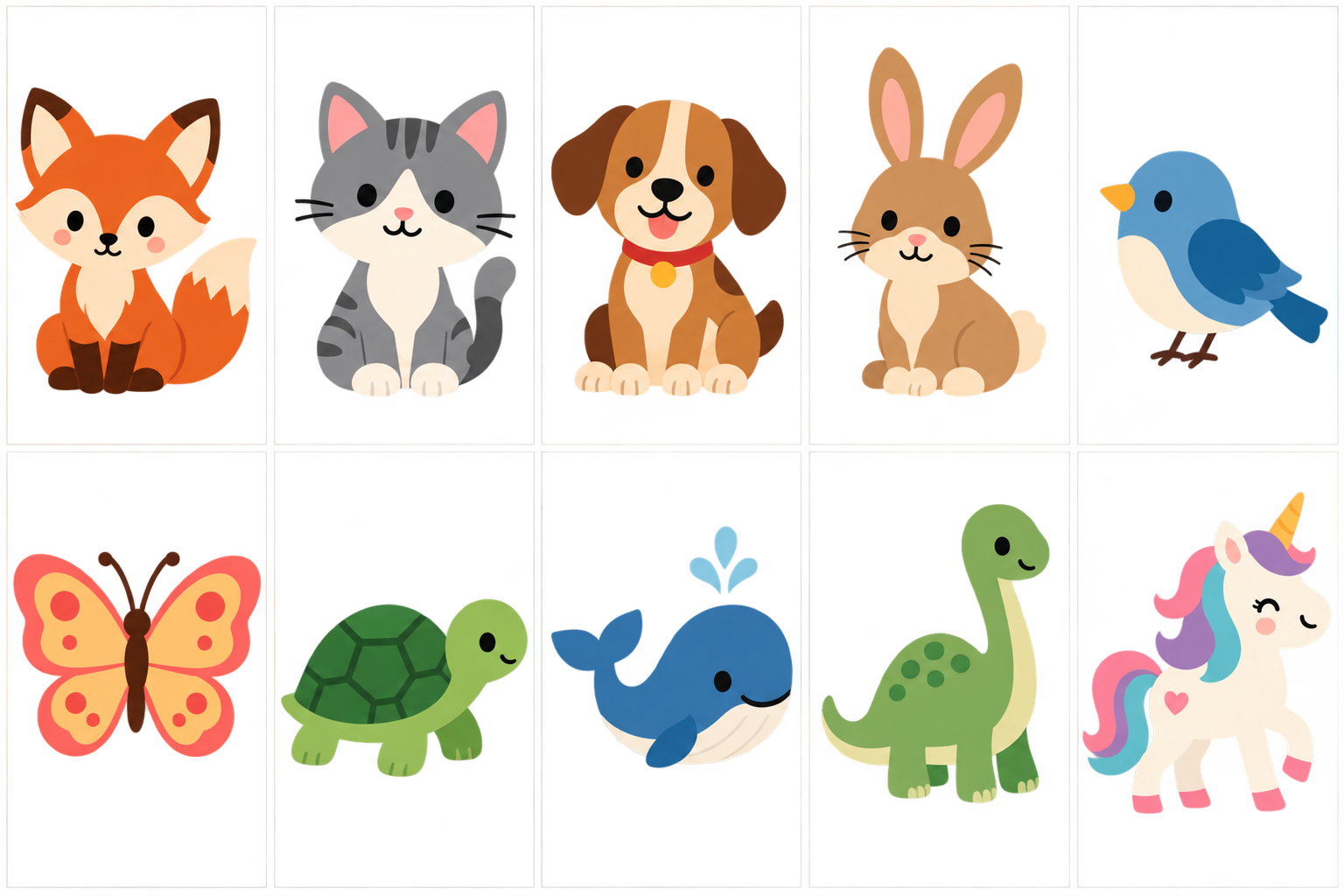
Artwork for the animal examples below. The illustration shows the subjects; the counted chart shows the work involved.
What makes a cross stitch pattern easy?
Use this checklist when comparing simple cross stitch patterns. These are starting preferences, not rules that every beginner must follow.
| Check | A manageable first choice | What can add difficulty |
|---|---|---|
| Design size | One motif whose whole chart you can inspect easily | Several motifs or a large stitched background |
| Stitch types | Full crosses with clear instructions | Fractional stitches, knots, or detailed backstitch |
| Color layout | Connected patches and visibly different shades | Scattered single stitches and similar shades |
| Thread key | Every symbol matched to a thread identifier | Missing symbols or color swatches without identifiers |
| Chart readability | Cells and symbols readable at your working size | A small preview enlarged until it becomes blurry |
For a first design exercise, a grid around 30 by 30 stitches and two to five colors is a useful starting point. It is not a definition of a beginner pattern: the arrangement of those colors matters just as much as their number. A two-color checkerboard still changes color constantly.
Compare the animal artwork with its counted chart
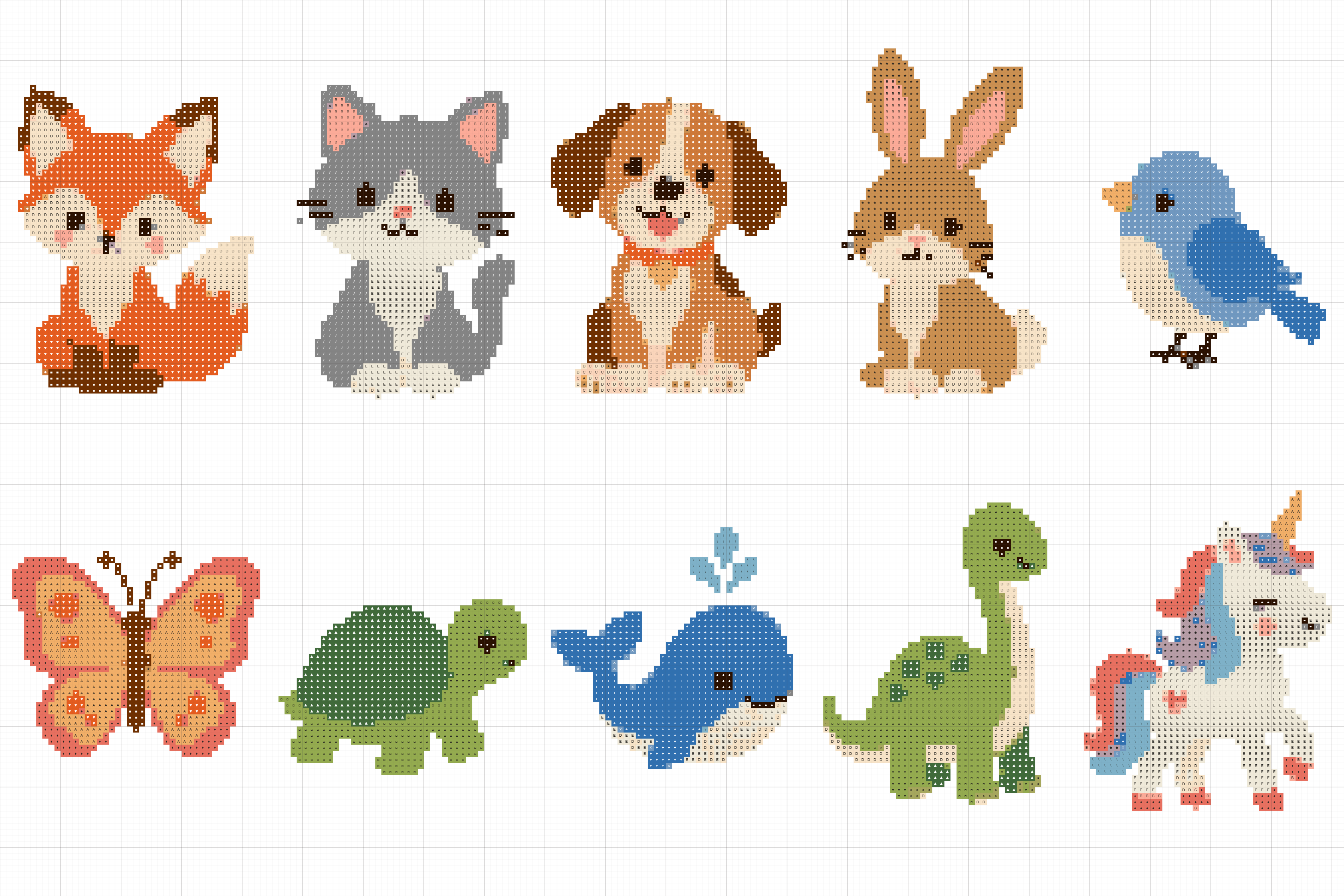
This overview is an example for comparing complexity, not a complete printable pattern booklet. Open the full-size chart image to inspect the cells. No complete PDF for this animal collection is included here.
The bird, turtle, and whale are useful places to begin comparing the chart: each has broad color areas and a recognizable outline. The cat has separate stripes and whiskers to keep track of. The unicorn has several mane and tail colors distributed across narrow sections. Those observations help you decide which type of counting you would enjoy; they do not establish an exact difficulty rating or completion time.
Try this before committing to any animal pattern:
- Choose one subject and inspect its complete chart, including detached details such as the whale's water droplets.
- Find its smallest features. Check that you can distinguish the symbols for the eyes, mouth, and outlines.
- Trace one color through a few rows. Notice whether it forms a connected patch or repeatedly starts and stops.
- Check which colors that motif actually uses. A collection-wide thread list can include colors needed only by other animals.
The soft background in the original artwork does not appear as stitched background in the chart example. That is a meaningful simplification. When converting your own illustration, inspect the preview rather than assuming background shading will disappear automatically.
For help interpreting the cells, see how to read a cross-stitch chart.
Check the thread key before buying floss
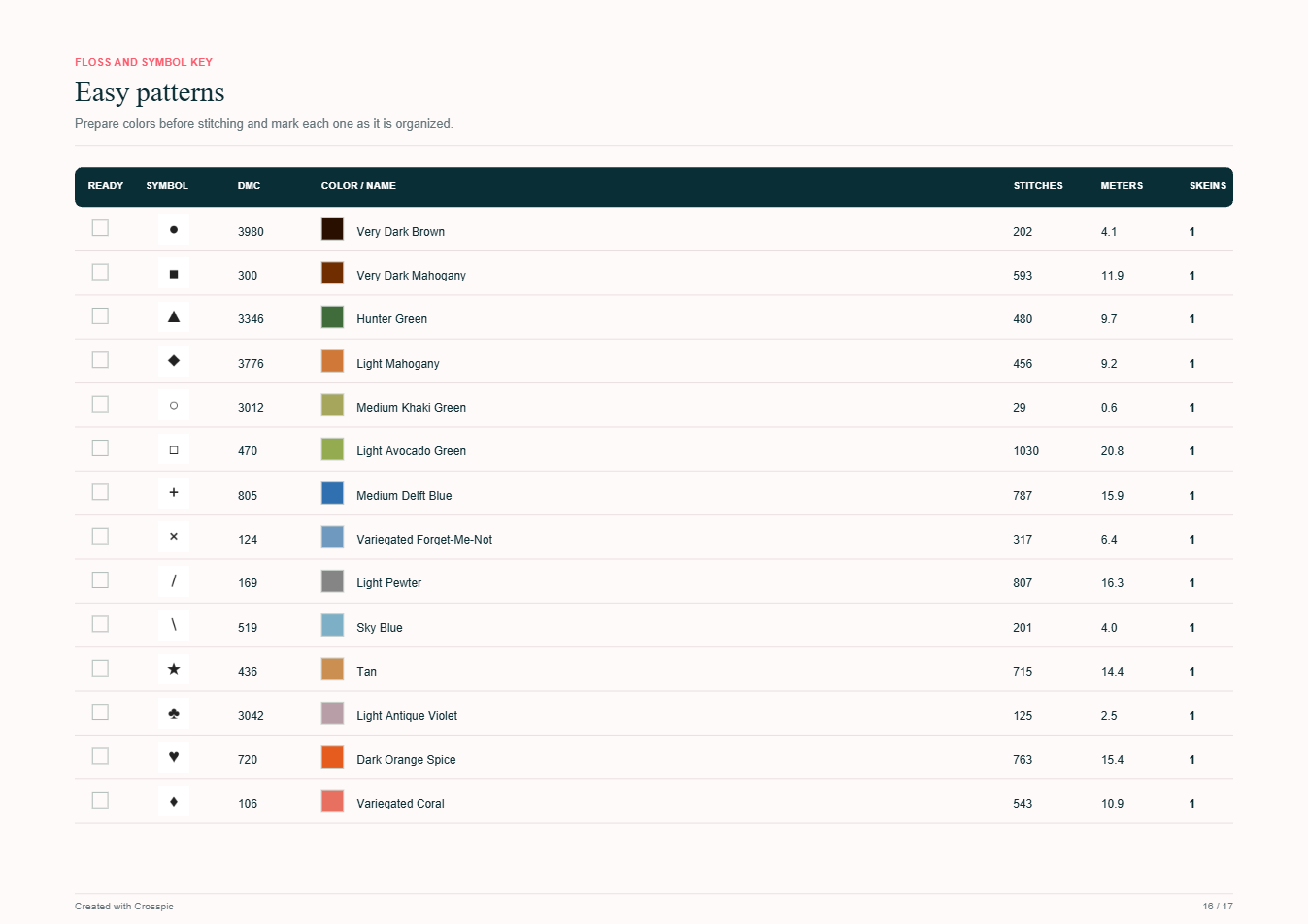
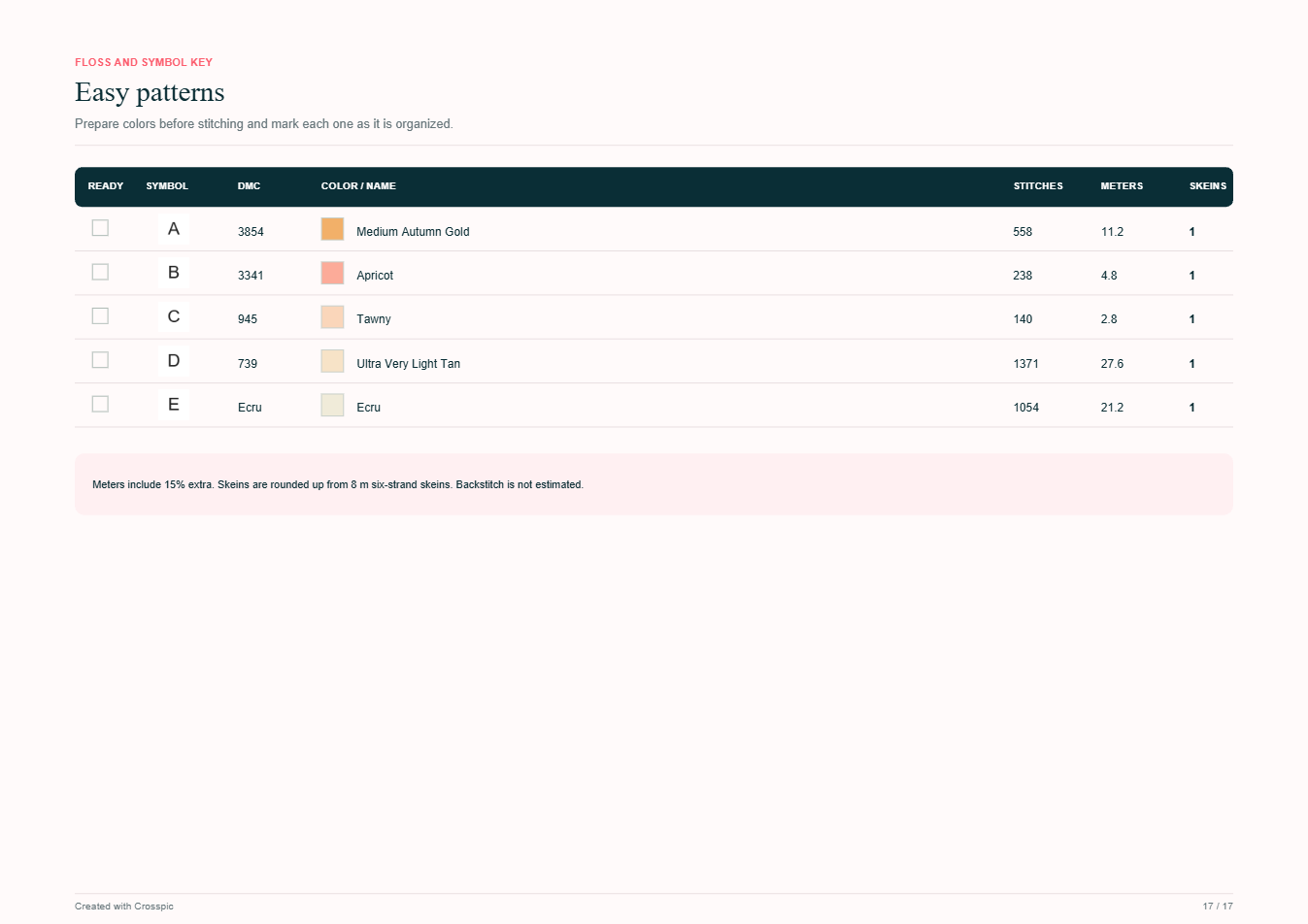
The supplied key has 19 color entries across two pages. It describes the collection, not a separate shopping list for every animal.
For example, this key maps D to DMC 739 and E to Ecru. Use those identifiers to distinguish the threads rather than trying to match their pale screen swatches by eye. Symbol assignments belong to this chart; another pattern can use D for a different color.
The key also illustrates why stitch counts matter. It lists 29 stitches for one color and 1,371 for another. A low count tells you to inspect that color's role, not automatically remove it: a few stitches can supply an important facial feature.
Treat the displayed thread quantities as planning estimates. The note on this example says the estimates include 15% extra and exclude backstitch. Check your own pattern's fabric and strand settings before using its estimates. Do not read the collection's quantities as the amount required for a single motif.
How small will the finished design be?
For full crosses over one square of Aida, calculate each dimension as:
Stitches along that edge ÷ fabric count = size in inches.
Multiply inches by 2.54 for centimeters. Here are hypothetical square grids, not measurements of the animals above:
| Grid | On 14-count Aida | On 16-count Aida |
|---|---|---|
| 30 × 30 stitches | 2.14 × 2.14 in / 5.44 × 5.44 cm | 1.88 × 1.88 in / 4.76 × 4.76 cm |
| 40 × 40 stitches | 2.86 × 2.86 in / 7.26 × 7.26 cm | 2.50 × 2.50 in / 6.35 × 6.35 cm |
| 50 × 50 stitches | 3.57 × 3.57 in / 9.07 × 9.07 cm | 3.13 × 3.13 in / 7.94 × 7.94 cm |
These are grid dimensions, rounded separately from the unrounded calculations. Add fabric for handling and your chosen finish before cutting. A motif may occupy less than its full grid if the chart includes empty borders.
A 30-by-30 grid has 900 possible stitch positions; a 60-by-60 grid has 3,600. Doubling both dimensions creates four times as many cells. Empty cells need no stitching unless the pattern says otherwise, so grid area is not necessarily the actual stitch count.
Changing to a higher fabric count makes the same chart physically smaller. It does not reduce the number of stitches or simplify the color changes. DMC's guide to cross-stitch fabric is a useful reference when choosing fabric.
What to check in free cross stitch patterns
Browse Crosspic's free cross stitch patterns for the unicorn PDF and editable samples, then use the checks below to decide which project suits you.
When looking for free counted cross stitch patterns, check what the download actually contains. A finished picture, a chart preview, and a complete working pattern serve different purposes.
Before gathering supplies, confirm that you have:
- The complete chart, with all sections and readable symbols.
- A key matching every used symbol to a thread identifier.
- Stitch dimensions, stitch-type instructions, and fabric and strand guidance.
- Clear page alignment if the chart is split across sheets.
For an existing Crosspic download, visit the free unicorn cross-stitch pattern. That page includes a printable PDF and previews. Review its chart with the checklist above before deciding whether it suits your first project; a free download does not automatically mean an easy pattern.
If you mean a blank grid by “free cross stitch templates,” the cross stitch chart maker is the relevant starting point. It lets you draw a design rather than download a finished motif.
Make a manageable first pattern in Crosspic
For a small original design, open the blank pattern creator, try a 30-by-30 grid, and draw a heart or another bold shape using a few colors. The first-pattern walkthrough explains that workflow in detail.
If you already have artwork, the image-to-pattern workflow offers another route. Crop around one subject, choose stitch dimensions, and compare the preview at a modest color limit. Review the eyes and outline before accepting fewer colors. More background and more subjects usually mean more to inspect.
After conversion, inspect scattered stitches and nearby shades. Use the palette cleanup guide when colors add work without useful detail. Check the symbol view, then preview the printable chart before exporting the PDF. Keep a separate .crosspic backup if you want to edit it later.
Questions before your first project
How many colors should a beginner pattern have?
Two to five is a useful starting range for a small practice motif, but there is no required limit. Look for connected color areas and clear contrast. Several colors in large patches may be easier to follow than two colors scattered across every row.
Can I stitch just one animal from a collection?
Yes, if you have its complete chart and matching key. Include detached details, establish the selected motif's dimensions and starting point, and identify its thread colors. The whole collection's size and floss totals will not describe that one animal.
Can I stitch from an illustration or small preview?
An illustration does not tell you where each cross goes. Use a readable counted chart with a matching key. A screenshot that loses its symbols when printed needs a clearer chart export, not guesswork.
Choose one motif you can follow comfortably
Pick a subject you enjoy, inspect its smallest details, and confirm the chart and key are complete. Favor clear color areas and a manageable stitch count over a small-looking thumbnail. To put that into practice, open the designer and start with one simple shape.